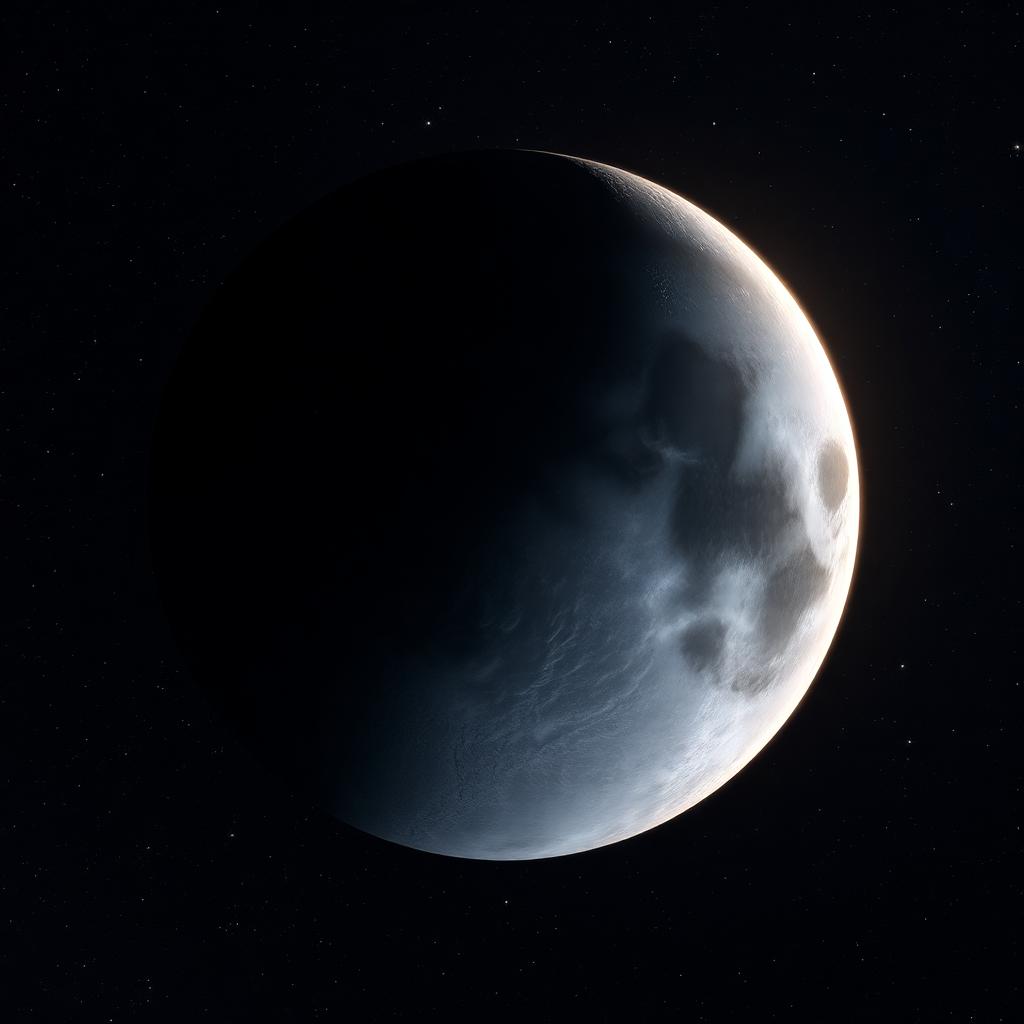
The Moon
Natural satellite
The fastest-moving body in the chart — and the most personal.
In the sky right now
Aquarius 3°04′
Ecliptic longitude 303.08°
Currently direct
Retrograde cycle
The Moon never retrogrades. It orbits Earth directly and continuously, covering roughly 12–15° of the zodiac per day and changing sign every two and a half days.
Astronomy
- Type
- Earth's only natural satellite
- Diameter
- 3,474 km (27% of Earth's)
- Distance from Earth
- 384,400 km on average
- Orbital period
- 27.32 days (sidereal)
- Phase cycle
- 29.53 days (synodic month)
- Rotation
- tidally locked — one face always toward Earth
- Surface gravity
- 1/6 of Earth's
- Recession
- drifting away from Earth about 3.8 cm per year
Planetary facts follow NASA and JPL reference data. Moon counts reflect IAU-recognised satellites as of August 2026. Zodiacal positions and retrograde stations are calculated live using the app's VSOP87/NOVAS-derived astronomy engine rather than being hard-coded. The lunar nodes shown are True (osculating) nodes, computed from the Moon's instantaneous orbital plane — the same convention Astro.com uses by default.
Greek & Roman mythology
Greek
Selene (also Artemis and Hecate in different aspects)
Roman
Luna
Selene was the Greek moon goddess proper — sister of Helios, driving a chariot of her own across the night sky. Her best-known myth is her love for the shepherd Endymion, granted eternal sleep so he would never age, whom she visited each night.
Artemis, a distinct Olympian, was a huntress and goddess of wild places and childbirth; her identification with the moon is a later development, common in Hellenistic and Roman-era literature but not in Homer. Hecate, associated with crossroads, thresholds and night magic, made up a third strand of what later writers treated as a triple lunar goddess.
The Roman Luna was worshipped with a temple on the Aventine Hill from an early date; the Romans also imported Diana (aligned with Artemis) and Hecate, keeping the same threefold pattern.
In a natal chart
The Moon is the inner life: emotion, instinct, memory, what soothes you, and how you respond before you think. Where the Sun is who you are becoming, the Moon is what you already carry.
Because it moves so quickly, an accurate Moon sign benefits from an accurate birth time — the sign can change within hours.
The Moon rules Cancer, is exalted in Taurus, in detriment in Capricorn and in fall in Scorpio.
Rules: Cancer
See where The Moon falls in your chartExplore the rest of the sky
Don't write your paper based on this page. We keep the facts as accurate as we can, but moon counts get revised, missions rewrite the textbooks, and the live positions are computed on the fly — treat this as a reliable starting point, not a real-time oracle.