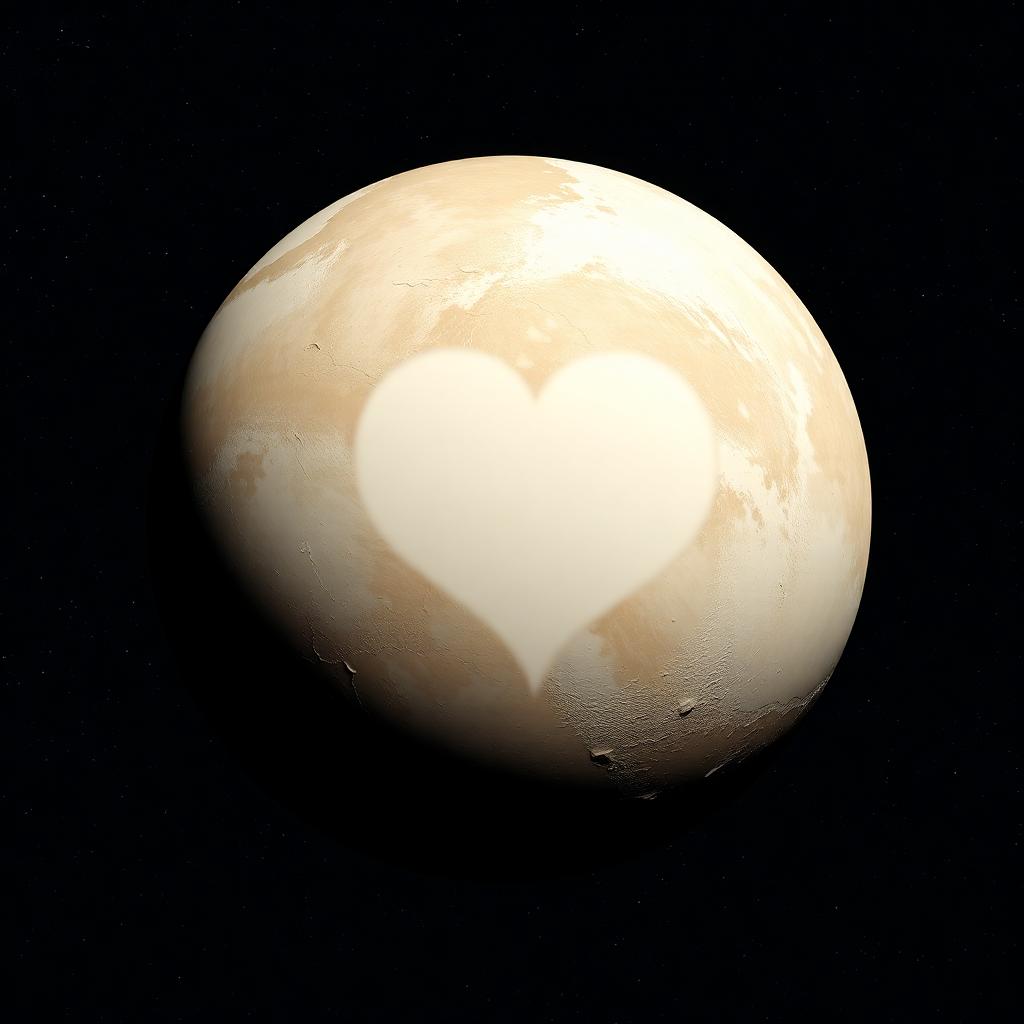
Pluto
Dwarf planet
Power, depth, death and what comes after it.
In the sky right now
Aquarius 3°04′
Ecliptic longitude 303.07°
Currently direct
Daily motion 0.002° per day
Retrograde cycle
- StatusDirect
- Last went directOct 16, 2026
- Next retrograde beginsMay 8, 2027
- Next retrograde endsOct 18, 2027
- Pluto retrogrades once a year for roughly five to six months.
Astronomy
- Discovered
- 18 February 1930, by Clyde Tombaugh at Lowell Observatory
- Named by
- Venetia Burney, an 11-year-old in Oxford, England
- Reclassified
- Dwarf planet by the IAU on 24 August 2006
- Average distance from the Sun
- 5.9 billion km (39.5 AU)
- Orbital period
- 248 Earth years
- Diameter
- 2,377 km — smaller than Earth's Moon
- Moons
- Five: Charon, Nix, Hydra, Kerberos and Styx
- Visited
- New Horizons flyby, 14 July 2015
Planetary facts follow NASA and JPL reference data. Moon counts reflect IAU-recognised satellites as of August 2026. Zodiacal positions and retrograde stations are calculated live using the app's VSOP87/NOVAS-derived astronomy engine rather than being hard-coded. The lunar nodes shown are True (osculating) nodes, computed from the Moon's instantaneous orbital plane — the same convention Astro.com uses by default.
Greek & Roman mythology
Greek
Hades (also called Plouton)
Roman
Pluto (Dis Pater)
Hades ruled the underworld and, unusually among Greek gods, was rarely depicted or invoked by name — speaking it was thought to attract his attention. He was more often called Plouton, 'the wealthy one', because the earth's mineral riches were his; that euphemism is the direct source of the planet's name.
His central myth is the abduction of Persephone, whose mother Demeter let the world go barren until a compromise was struck: Persephone spends part of the year below and part above, which is the Greek account of the seasons.
The Roman Pluto absorbed Plouton entirely, and overlapped with the older Roman Dis Pater, likewise a god of underground wealth and the dead.
The 2006 reclassification to dwarf planet was an astronomical decision about orbital dominance. Astrologers continued to use Pluto unchanged, since astrological practice is not defined by the IAU's categories.
In a natal chart
Pluto governs transformation, power, obsession, buried material and regeneration — what is destroyed and rebuilt rather than merely changed.
Its highly elliptical orbit means it spends between twelve and thirty-two years in a sign, so its placement describes a whole generation.
Pluto is the modern ruler of Scorpio, which traditionally belonged to Mars.
Rules: Scorpio (modern)
See where Pluto falls in your chartExplore the rest of the sky
Don't write your paper based on this page. We keep the facts as accurate as we can, but moon counts get revised, missions rewrite the textbooks, and the live positions are computed on the fly — treat this as a reliable starting point, not a real-time oracle.